All authors have their opinions about the ‘rules’ of writing. Be concise or not, write stories this way, end them this way, blah blah blah. It should be no shock then that there are varied opinions about dialog tags. And shock of all shocks, I’ve got mine. (It’s not a shock to anyone who’s poked around my social media or blogs. I’m admittedly an opinionated brat.)
I ran into a thread on Twitter discussing dialog tags. We all remember English class in school. Many of us remember being told to use said as a dialog tag. Even editors at publishing companies tell authors to use said as a dialog tag. (Fun fact: My English teacher junior year in HS HATED my writing. To the point my parents called the school to complain.)
But, as authors, particularly fiction authors, our responsibility is to our readers. It is quite literally our job to keep them interested, engaged, and entertained. A bored reader is a reader who will not finish our book and will not give any other of our books a chance. There will always be readers who do not like our books. But I’d be a lot happier about it if it were because they didn’t like the story itself or the genre.
One thing our English teachers got right is to vary the writing. Don’t use the same sentence structure every time. Don’t use the same cliches, descriptions, etc. Repetition in a fiction book tends to be boring. This also applies, in my humble opinion, to dialog tags.
We’ve all been told to use said as a dialog tag. That it’s the only accurate tag we can use. I’ve even been told people don’t actually breathe with regard to speaking. As in, “Don’t leave me,” she breathed. That isn’t actually what she’s doing. She’s lowering her voice and speaking softly. Fine. Whatever.
But who wants to read, “Don’t leave me,” she lowered her voice and spoke softly? Or, “Don’t leave me,” she said. One is longer than necessary, and the other has no emotion in it. Dialog tags are an excellent way to communicate thoughts and emotions with one simple word.
For example, “Don’t leave me,” she stuttered. Or, “Don’t leave me,” she breathed. One conveys possible cold (temperature, as in shivering) or nerves, the other, maybe shyness, she’s unsure of herself, or attraction. It all depends on the scene.
A particular author was referenced. (I’m adding a screenshot I found of some of her writing to use as an example. I am not naming the author or the book. I will not shame this author, as they are more experienced and more popular. Please don’t search this out.) Once I found an example of her writing, I found I agreed. Using only said as a dialog tag is boring. And sadly, I won’t be reading any books by this author because of this.
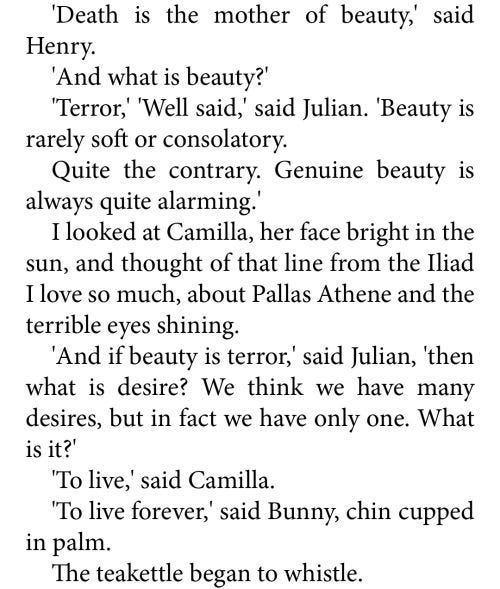
See? Boring. Just in this little screenshot, the word said has been used 5 times as a dialog tag, and 1 more in actual dialog. Out of 106 words, 5 are said as a tag. In a 100,000-word book, that’s approximately 4,700 times the word said would be used. If you figure approximately 300 words per page, that comes out to almost 16 pages of the word said. (I’m going to ignore the glaring grammar mistakes for the sake of my brain. That’s a whole different subject best left to another blog.)
I got bored just reading the sample above. Never mind an entire book written like this. This book would most definitely be a DNF for me. It would put me to sleep. And not because I was relaxed. If I’m being honest, I find the overuse of the word said (or any dialog tag or word) lazy, and as someone else said, unimaginative.
This is one ‘rule’ of writing I will encourage you to ignore. Using only said is boring. Don’t do it unless you want to risk losing readers. It’s not the invisible tag publishers and some authors say it is.
Common dialog tags I’ve seen in fiction (romance, fantasy, PNR, suspense, mystery, etc.):
Growled, sighed, breathed, deadpanned, whispered, stuttered, admitted, ranted, snapped, and so many others. They convey so many things about the scene in 1 word.
I’m not much of a rule follower, but this is one rule I’m going to hope you follow: Be creative in your use of dialog tags. Said is okay, but very sparingly. Look for a tag that conveys the emotion of the scene. Working to describe the scene in a way that engages the readers only to lose that engagement by using the word said is a wasted effort.
- Note* Again, please don’t search out this writing sample. I’m not out to shame this author as they have more experience and are much, much more popular. I believe they even have a book turning into a movie. This blog is from the viewpoint of a reader. As a reader, *I* found it boring.
Happy writing! And don’t be lazy while doing it. Google is there for a reason. Google dialog tags and it’ll give you tons. Comments and thoughts are welcome, but please be civil.
 Andrea Green Books & Reviews